Physical AI & aerial robotics

Learning to act
in the physical world.

Learning-based perception, decision-making, and control for autonomous robots. My focus is aerial systems: bringing vision-language models and reinforcement-learning policies from computation to flight.

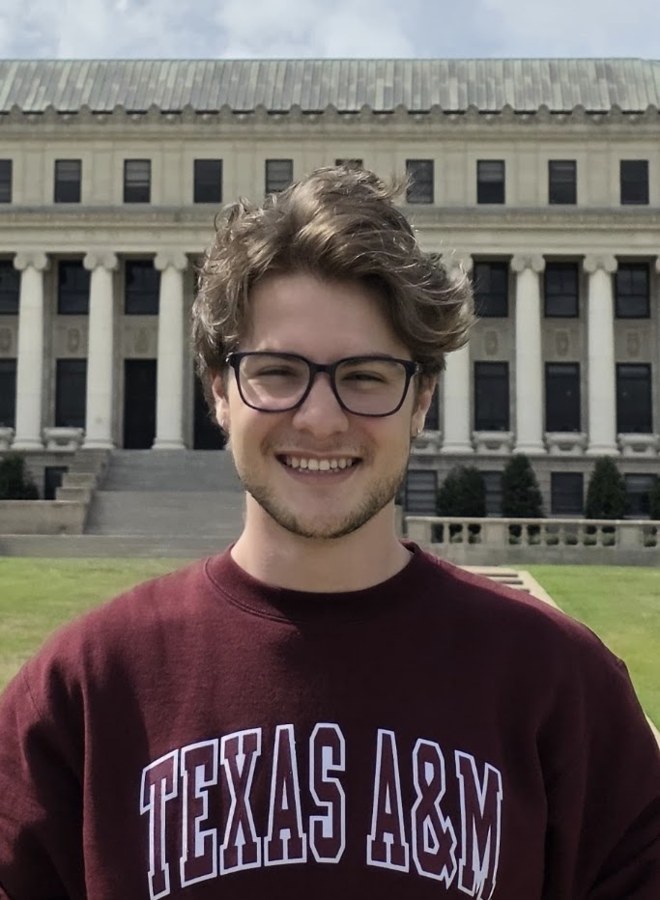
Portrait of Marco Soprani Tayar
Marco Soprani Tayar · São Carlos, Brazil
Marco Soprani TayarUniversity of São Paulo · Brazil
01 / Selected work

Models meet machines.

From language and perception
to closed-loop physical action.

02 Learned control deployment

MIRA / IMAV 2026

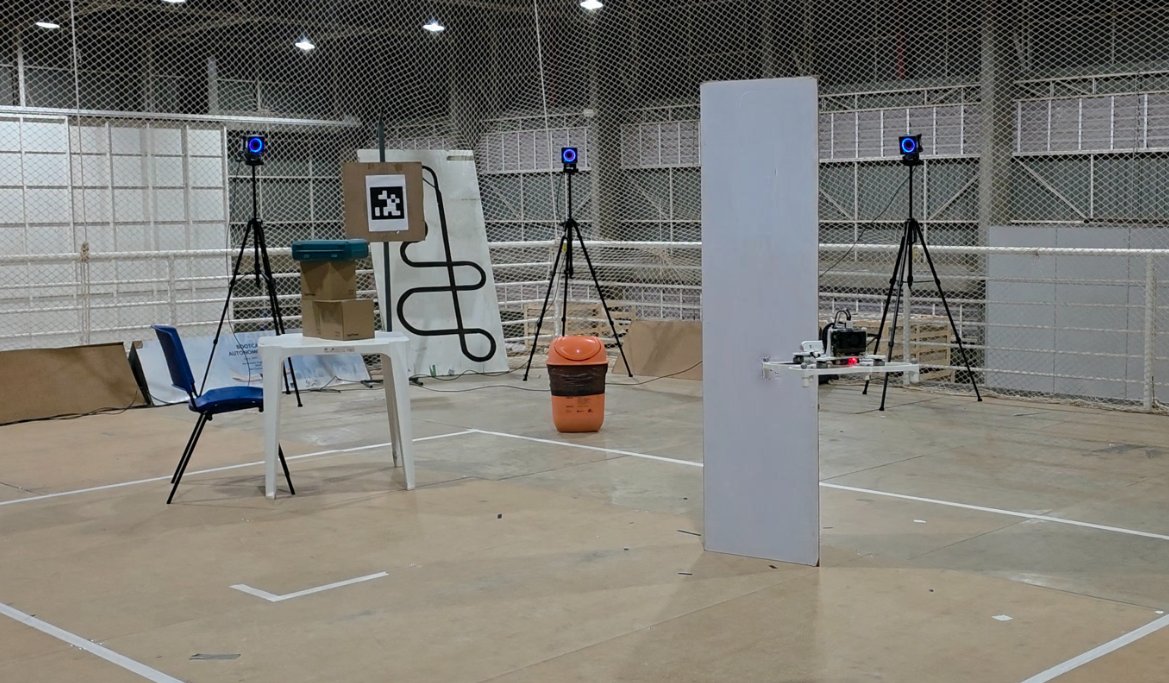
Deploying a pretrained reinforcement-learning flight policy on a custom drone and integrating it with GPS-denied autonomous navigation.

My work Integration and deployment of pretrained RAPTOR control within a stack combining lidar-inertial odometry, mission logic, and PX4. I did not train the RAPTOR policy.

Onboard deploymentFAST-LIO2PX4
System & competition

The Mobile Robotics Group’s custom drone uses lidar-inertial odometry as its position source, behavior trees for mission logic, and a pretrained learned control policy inside the flight controller. The system was validated in simulation before flight. The team placed fourth indoors and received the Most Promising Team award at IMAV 2026.

03 Learned perception & estimation

Relocalization beyond odometry

Combining learned visual features with geometric estimation to correct accumulated drift against a prebuilt map.

My work Separating local VIO from global relocalization, then fusing map-based corrections in a GTSAM pose graph for navigation.

Learned featureshloc / COLMAPGTSAM
Approach & tools

Local estimation uses visual-inertial odometry. An offline mapping and relocalization pipeline explores SuperPoint, AnyLoc/DINOv2, and LightGlue with COLMAP. Global fixes are fused into the local estimate and passed to the flight controller. I also explored 3D Gaussian Splatting as an alternative map representation.

02 / Research direction

Intelligence under
real-world constraints.

I’m interested in how learned models can enable reliable robot autonomy when sensing is imperfect, compute is limited, and actions have physical consequences.

01

Vision, language & action

Grounding high-level instructions in robot perception and executable motion.

02

Reinforcement learning & control

Adapting policies to physical platforms and understanding the simulation-to-hardware gap.

03

Onboard intelligence

Model optimization and integration under latency, memory, and runtime constraints.

03 / Publications

Research in writing.

Recognition & service

Competition-tested.

04 / Background

A model-to-robot
perspective.

I’m a Mechatronics Engineering student at EESC, University of São Paulo, and a researcher in Prof. Marcelo Becker’s Mobile Robotics Group at the USP Center for Robotics.

My work connects model training and deployment with state estimation, planning, and embedded autonomy. Alongside aerial robotics research and international drone competitions, I work on robotic navigation and inspection for industrial environments.

Read my CV ↗
Current

USP Center for Robotics

Mobile Robotics Group · Robot learning & field autonomy

2026

Texas A&M University

Research Intern · Advanced Vertical Flight Laboratory
GPS / GPS-denied estimation transitions · Dr. Moble Benedict

2025

Embraer

Avionics Intern · Sensor integration and flight systems

2023–2025

SEMEAR Robotics Group

Aerial robotics leadership & embedded autonomy

2023–2027

EESC / University of São Paulo

Mechatronics Engineering · Expected graduation 2027

Let’s connect

Building intelligence
that moves.

marcotayar@gmail.com ↗